
Claims don't convert. Proof does.
Trusted, experienced and high quality are claims anyone in your trade can type. Proof is the part a visitor can check for themselves, and it is usually already sitting on your phone.
Open five websites in your category and you will read the same four words. Trusted. Experienced. High quality. Customer first. Different logos, same sentence.
That is not a writing problem. It is an evidence problem. A claim is something a business says about itself. Proof is something a visitor can check without taking your word for it. Only one of those survives a skeptical homeowner holding a phone at nine at night.
So the useful question is not whether your website sounds convincing. It is whether a stranger can verify anything on it before they decide to call you or close the tab.
The words that prove nothing
| The claim | What it invites |
|---|---|
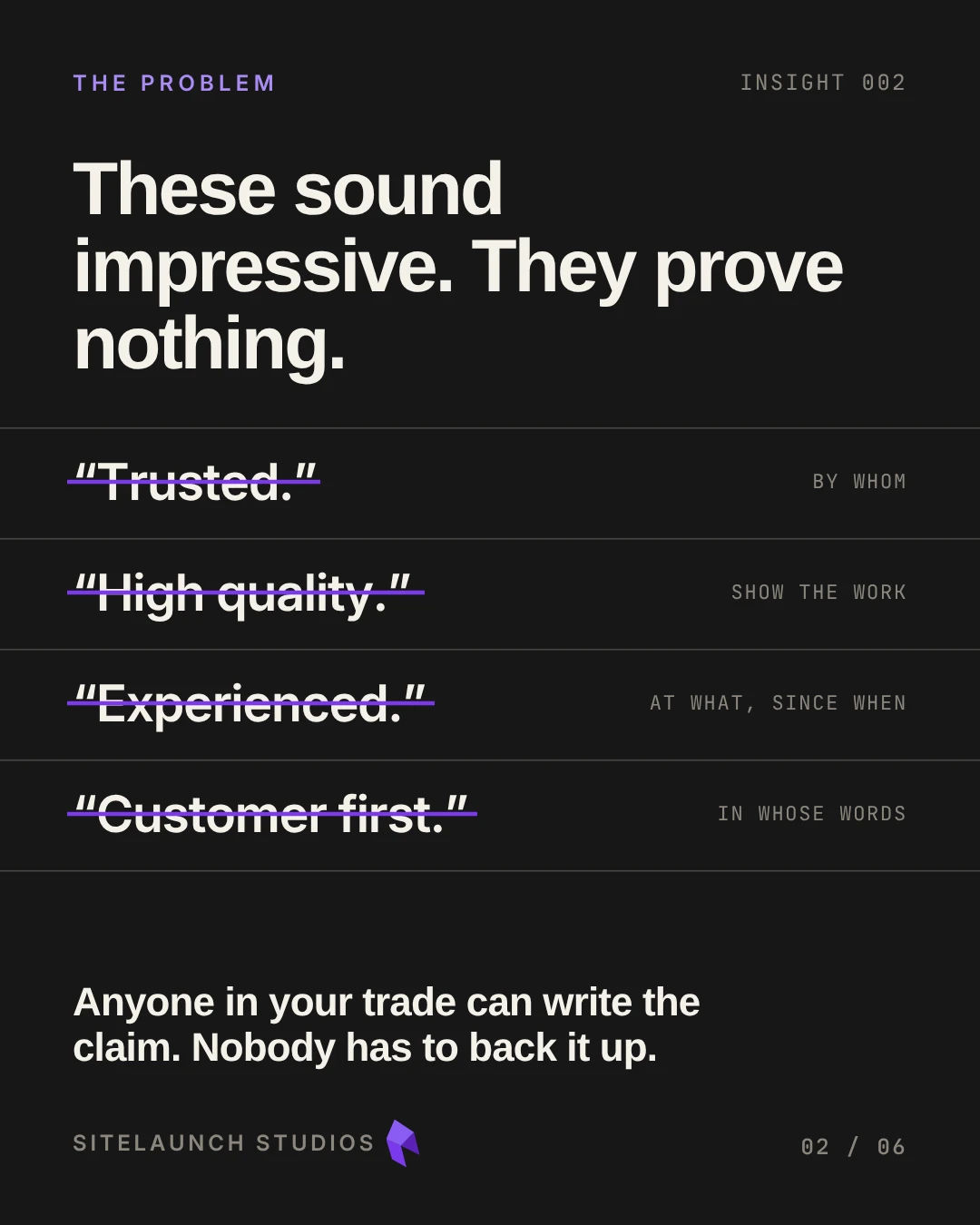
| “Trusted.” | By whom? |
| “High quality.” | Show the work. |
| “Experienced.” | At what, and since when? |
| “Customer first.” | In whose words? |
Anyone in your trade can write the claim. Nobody has to back it up. That is exactly why it carries so little weight: it costs nothing to say, so it proves nothing to read.
What a visitor can actually check
A proof audit is the first pass we run on most websites. It is not a design critique and it has nothing to say about taste. There is one question: what could a first time visitor confirm independently, using only the page in front of them?
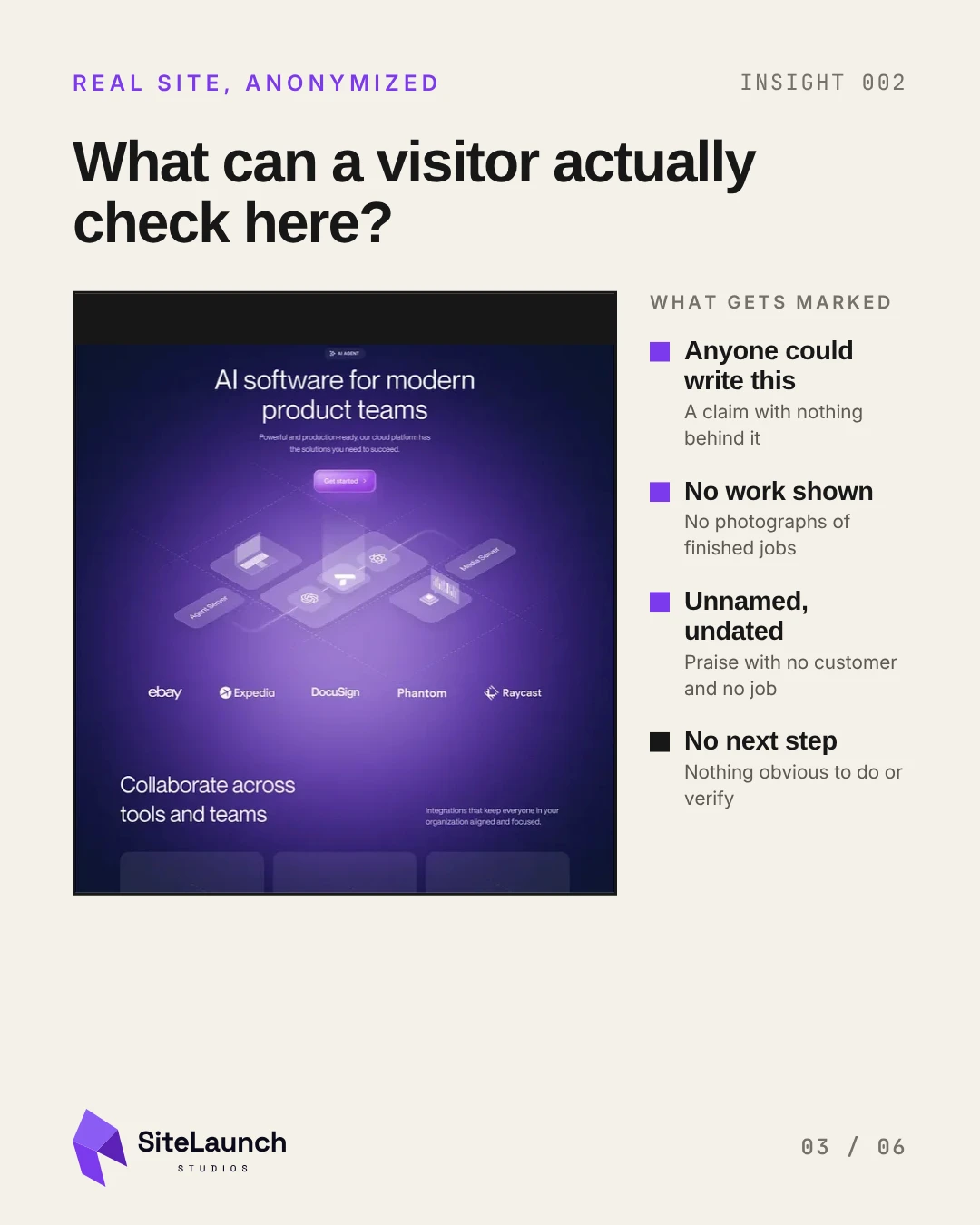
Here is a real example with the branding removed. A polished, modern site. Strong headline, confident product imagery, a row of recognizable logos near the fold. It looks expensive, and almost nothing on it can be checked.
What gets marked
- 01Anyone could write thisA claim with nothing behind it.
- 02No work shownNo photographs of finished jobs.
- 03Unnamed, undatedPraise with no customer and no job attached.
- 04No next stepNothing obvious to do or verify.
None of those are cosmetic faults. Each one is a point where the visitor has to decide whether to believe you, with nothing to go on but tone. Some will. Most will open a second tab and compare you against someone who made it easier.
Seven things that turn a claim into proof
- 01Real workPhotographs of finished jobs, labeled with the service and the area.
- 02Verified reviewsThe full text, the customer's name, and the job they booked.
- 03Specific servicesWhat you do, in the words your clients already use for it.
- 04Service areaThe neighborhoods and cities you actually cover, listed by name.
- 05Named processWhat happens after someone enquires, step by step.
- 06Real peopleNames, licenses, and who turns up on the day.
- 07Clear next stepOne obvious action, visible without scrolling.
Most businesses already have the raw material for all seven. The photographs are on a phone. The reviews are already on Google. The process exists, it just lives in your head instead of on the page. The licenses are in a drawer. Proof is usually a publishing problem rather than a production problem, which is why it is one of the cheaper things to fix.
The work is in the labeling. A photograph of a finished bathroom is decoration. A photograph of a finished bathroom captioned with the service, the area and what was actually done is evidence.
The same sentence, replaced with evidence
| Claim | Proof |
|---|---|
| “We do quality work.” | Project photography, with what was actually done underneath it. |
| “Customers trust us.” | A verified review from a real customer, shown in full. |
| “We make it easy.” | The visitor can see what happens next, straight away. |
Notice that the right hand column is not louder. It is more specific. Specificity is what makes a sentence checkable.
The strongest thing on your website is usually the thing your competitor cannot copy.
A competitor can copy your headline this afternoon. They can copy your palette, your stock photography and your list of services by the end of the week. What they cannot copy is the job you finished on a particular street, for a named customer who agreed to be quoted, documented with your own photographs.
That is the asset. Everything generic on your website is shared with your category. Everything specific belongs only to you.
Run this on your own site
Open your homepage on a phone and work down the list. Mark each one only if a stranger could confirm it without contacting you.
- At least three photographs of your own finished work, not stock imagery.
- Each photograph labeled with the service and the area it was done in.
- At least one review shown in full, with the customer's name and the job.
- Services written in the words a customer would say out loud, not industry terms.
- The areas you cover named individually, not described as “and surrounding areas”.
- What happens after an enquiry, written out as steps with no vague timing.
- A real person named somewhere on the site, with licenses where they apply.
- One obvious next step on the first screen, before any scrolling.
Anything you cannot mark is not a failure of effort. It is simply something true about your business that your website has not been asked to say yet.
Common questions
- What proof should a contractor website show?
- Photographs of your own finished jobs, reviews shown in full with the customer's name and the work they booked, the specific services you offer, the areas you cover listed by name, the people who turn up, any licenses that apply, and one obvious next step. Those seven signals cover most of what a homeowner checks before calling.
- Are testimonials enough to build trust?
- Not on their own. A quote with no name, no date and no job attached reads the same as one a business wrote about itself. A testimonial becomes proof when it is attributable: the full text, the customer's name, and the job they actually booked, ideally somewhere a visitor can go and check it independently.
- What if a new business does not have a large portfolio?
- Show what you have and be specific about it. Three jobs documented properly, with your own photographs and a plain description of the work, carry more weight than twenty stock images. Licenses, insurance, a named process and a clearly listed service area are all proof as well, and none of them require years of history.
- Where should proof appear on a service website?
- Start on the first screen, alongside the service, the area and the next step. Then repeat it next to each individual service, on the page where someone decides to enquire, and beside the form itself. Proof kept only on a separate testimonials page is proof that most visitors never reach.
- How many project examples does a small business need?
- Fewer than most people assume. Three to six well documented jobs that match the work you want more of will usually do more than a large unlabeled gallery. What matters is that each one names the service and the area, so a visitor can recognize their own situation in it.
Get a Free Website Review
Send me the site. I will show you the first three places I would add clarity, trust, or proof.